Picture a Tuesday afternoon. You're three meetings deep, your ops person just asked which of two client projects takes priority, and you realize your honest answer is “whichever one screamed loudest this morning.” That's not a hiring problem and it's not a discipline problem. It's a clarity problem — and it's the most common one I see walking in the door.
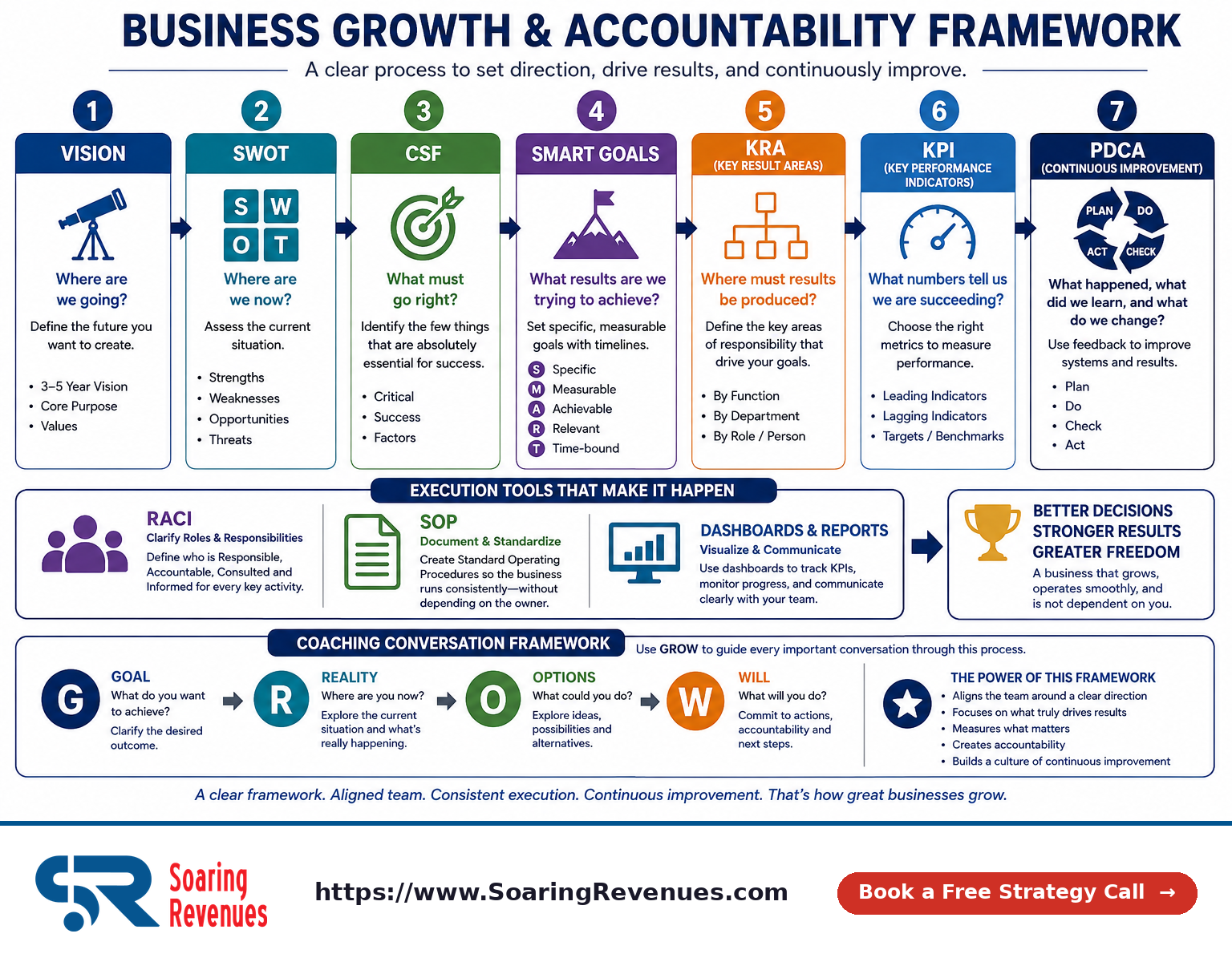
This framework is the one I come back to, over and over, because it answers seven questions in order, and each answer sets up the next one. You don't need to master all seven at once. You just need to know where you are right now and take the next rung.
Vision — Where are we going? Before anything else, you need a picture of the business three to five years out, and the core purpose underneath it. Not a slogan. A real answer to “why does this matter, and to whom.”
SWOT — Where are we now? An honest look at your strengths, weaknesses, opportunities, and threats. Most owners can name their strengths in their sleep. It's the weaknesses — said out loud, on paper — that actually move the needle.
CSF — What must go right? Critical Success Factors are the handful of things that, if they go wrong, nothing else matters. Naming three to five of these stops you from treating every fire as equally urgent.
SMART Goals — What results are we trying to achieve? Specific, Measurable, Achievable, Relevant, Time-bound. This is where vision stops being a feeling and starts being a number with a date attached.
KRA — Where must results be produced? Key Result Areas assign ownership. Every goal needs a home — a function, a department, a person — or it belongs to everyone, which means it belongs to no one.
KPI — What numbers tell us we're succeeding? Leading indicators, lagging indicators, and the targets that turn “I think we're doing okay” into “here's the number, and here's what it needs to be.”
PDCA — What did we learn, and what do we change? Plan, Do, Check, Act. This is the step most businesses skip, and it's the one that turns a one-time push into a system that keeps improving itself.
Underneath the seven steps sit the tools that actually make them stick — RACI to clarify who's responsible, accountable, consulted, and informed on every key activity; SOPs so the business doesn't depend on you being in the room; and dashboards so progress is something the whole team can see, not just something you carry around in your head.
And when it's time to actually talk about any of this with your team — in a one-on-one, a leadership meeting, wherever — I use GROW: Goal, Reality, Options, Will. What do you want, where are you really, what could you do, what will you actually commit to. It keeps every hard conversation moving forward instead of circling.
What this looks like in a real business
A landscaping company owner I think of often had a Vision step that was crystal clear — “become the go-to commercial property partner in the county” — but no CSF underneath it. Every SMART goal they set was about landscaping crews, when the thing that actually had to go right was winning and renewing commercial contracts. Once CSF got named honestly, half their goals changed.
A bookkeeping firm had the opposite problem: goals and KPIs everywhere, tracked beautifully, owned by no one. Adding KRAs — this metric belongs to this person, full stop — did more for their numbers in a quarter than any new goal would have.
A residential remodeling contractor had Vision, SWOT, and SMART goals nailed, but nothing like PDCA. Every quarter felt like starting over from scratch. Once Plan-Do-Check-Act became a standing 30-minute meeting, the lessons from one quarter actually carried into the next.
The examples above are illustrative composites built from patterns Coach Tarek sees across clients, not individual case studies.
Grab the chart below and keep it somewhere you'll actually see it — it's meant to be worked, not filed away. And if you look at it and think “I know exactly where we're stuck,” that's worth a conversation.