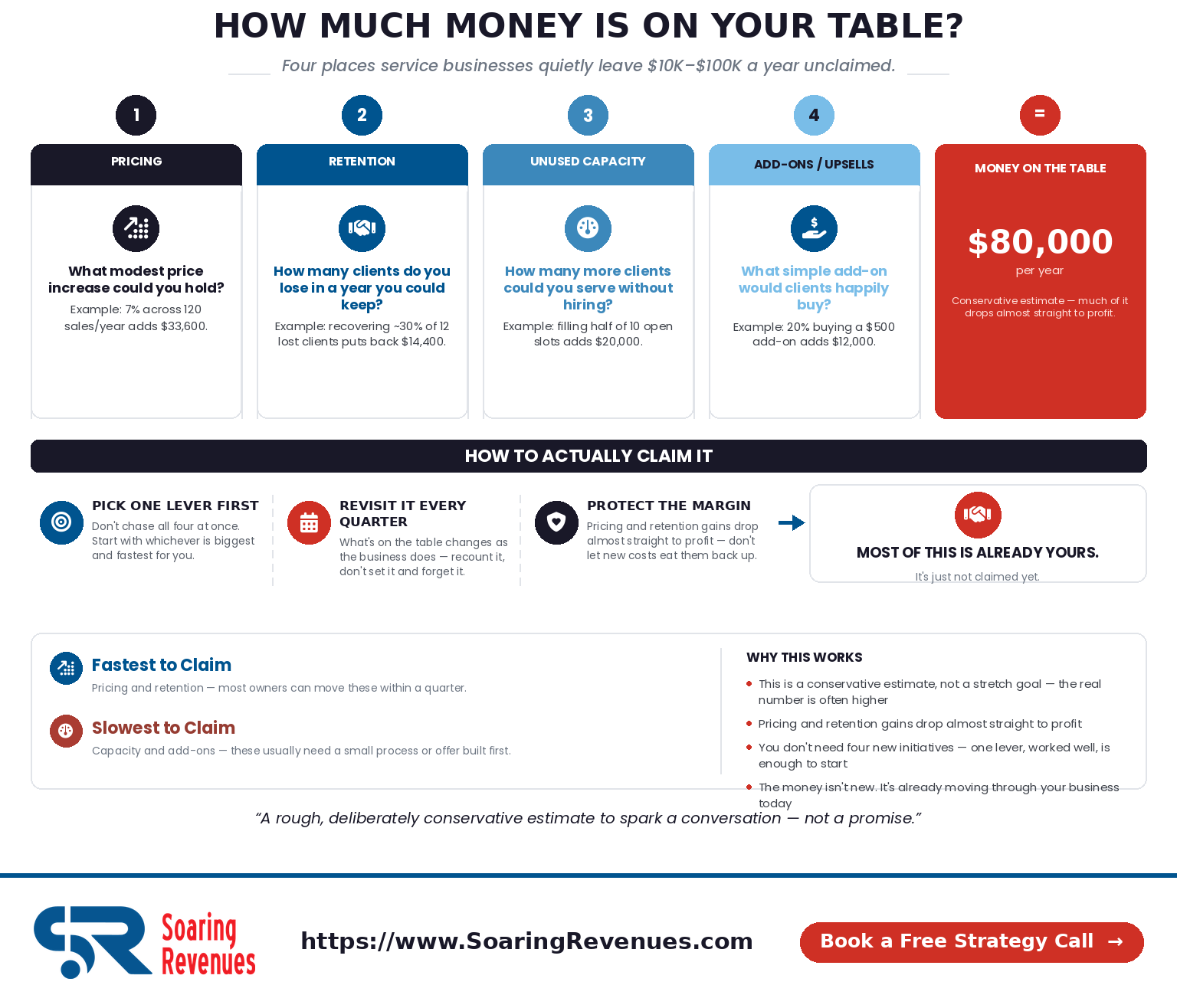
Most owners think growth means finding something new — a new service, a new market, a new marketing channel. And sometimes it does. But before you go looking for something new, I want you to look at what's already sitting in your business, unclaimed, in four places almost every service business quietly leaves money: pricing, retention, unused capacity, and add-ons. Conservatively, that's usually somewhere between $10,000 and $100,000 a year. Not hypothetical money. Money already moving through your business today, just not landing in your pocket yet.
Let's walk through the four, with a real worked example so the numbers feel like numbers instead of theory.
Pricing. What's a modest increase you could hold without losing your best clients? Take 120 sales a year at $4,000 each, and even a 7% increase — small enough that most clients won't blink — adds $33,600 a year. That's not a new client. That's the same clients, priced like the value you already deliver.
Retention. How many clients do you lose in a year that better follow-through could have kept? If you're losing 12 clients a year and could realistically recover about 30% of them with a stronger process, that's $14,400 back — clients you already had, who didn't need to leave.
Unused capacity. How many more clients could you serve this year without hiring anyone new? Filling even half of 10 open slots, at that same $4,000 average, is $20,000 — capacity you're already paying for whether you use it or not.
Add-ons and upsells. What's a simple add-on some clients would happily buy if you actually offered it? If a fifth of your clients would take a $500 add-on, that's $12,000 — value your clients wanted, that nobody thought to ask them for.
Add it up — $33,600, $14,400, $20,000, $12,000 — and you get $80,000 a year on the table, conservatively, for a business that size. I want to underline “conservatively,” because this is deliberately the cautious version of the math. Your real number is often higher. And most of it drops almost straight to profit, because pricing and retention gains don't cost you anything extra to deliver.
Here's how to actually go get it, because a number on a chart doesn't pay anybody's bills. Pick one lever first — don't try to chase all four at once, because that's how none of them get finished. Pricing and retention are usually the fastest to move, often within a quarter, since they don't require building anything new. Capacity and add-ons are usually the slowest, because they typically need a small process or offer built before they pay off. And once you've claimed a lever, protect it — revisit the whole picture every quarter, because what's on the table changes as your business does.
What this looks like in a real business
A pest control company had never raised prices in three years because the owner was afraid of losing customers. A modest, well-communicated increase held onto 96% of the client base and added real margin within one billing cycle — the fear turned out to be much bigger than the actual risk.
A physical therapy clinic was losing patients mid-treatment plan without ever finding out why, because nobody owned the follow-up call when a patient missed an appointment. One person, one weekly list, one phone call — and the retention lever alone paid for itself many times over.
A boutique photography studio had unused capacity every single week — open shooting slots nobody was actively selling — sitting right next to an add-on almost every client would have said yes to that no one on the team was trained to offer. Neither lever needed new clients. Both needed someone to actually ask.
The examples above are illustrative composites built from patterns Coach Tarek sees across clients, not individual case studies.
Run your own numbers below — it takes about a minute, and the estimate is intentionally conservative, so what you see is a floor, not a ceiling. Once you've got your number, the honest next step is picking the one lever with the biggest, fastest payoff for your business specifically.