I've sat across the table from a lot of owners who are terrified to raise their prices, and the fear always sounds the same: “What if everyone leaves?” I understand it — nobody wants to picture their best clients walking out the door over a number. But here's what I've learned running the actual math with client after client: the fear is almost always bigger than the real risk. Not a little bigger. Dramatically bigger. And the only way to see that clearly is to stop guessing and run the number.
There are really two questions hiding inside “should I raise my prices,” and they're both answerable with simple math, not nerve.
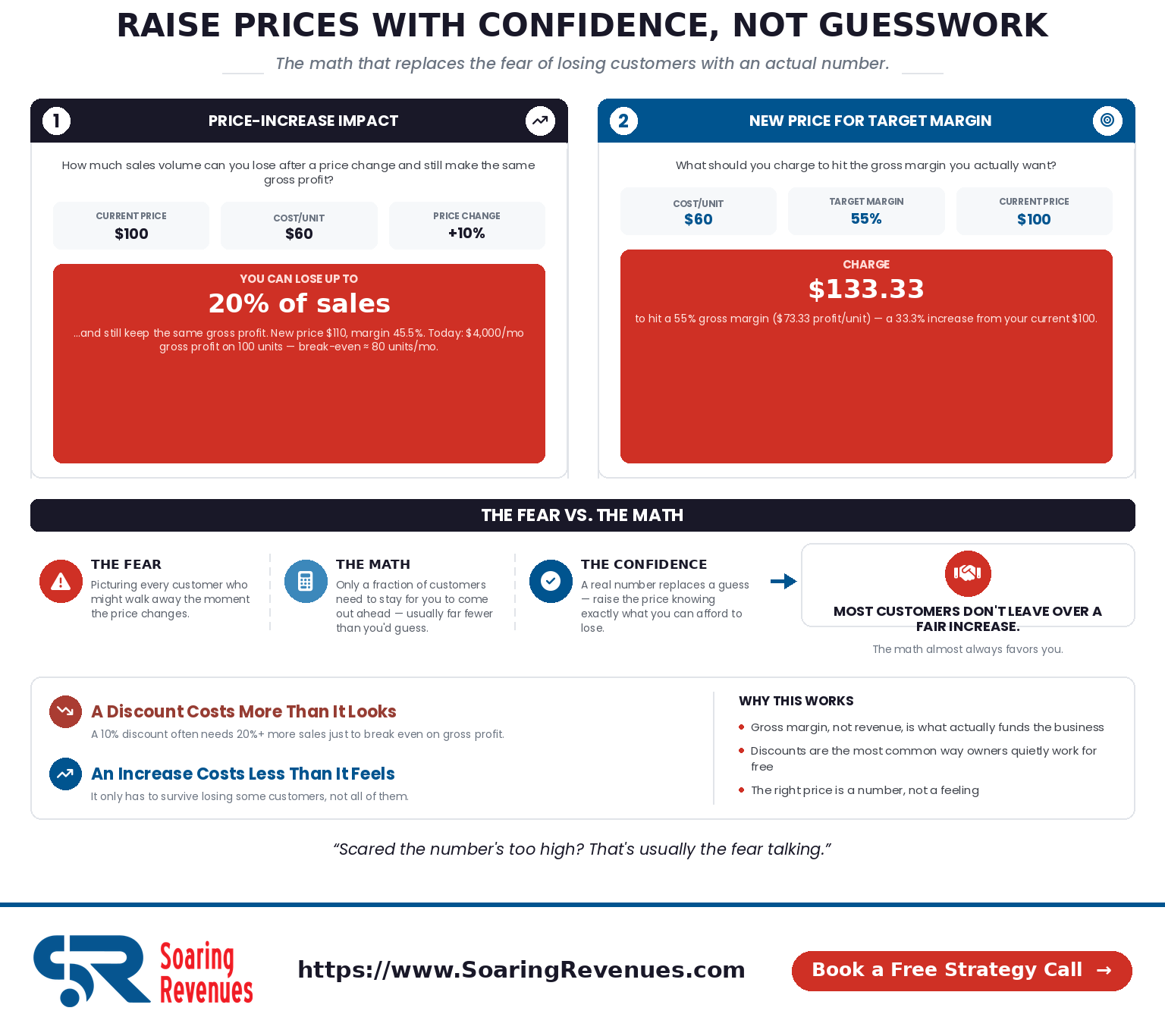
The first question: if I raise my price, how much business could I actually afford to lose and still come out ahead? Take a service priced at $100, costing you $60 to deliver — a 40% gross margin. Raise the price 10%, to $110, and your margin climbs to about 45.5%. Here's the number that should change how you think about pricing forever: you could lose up to 20% of your sales and still make the exact same total gross profit you're making today. One in five customers could walk, and you'd break even. Anything better than that, and you're ahead.
The second question is different: what should I even be charging? If you know your cost per unit and the margin you actually want to run at, the math tells you the price directly — no guessing, no copying a competitor's number. A $60 cost with a 55% target margin means you need to charge $133.33. If you're currently at $100, that's a 33% increase — a number that probably feels uncomfortable to say out loud, and is also just what the math says your price should be if you want to run the margin you decided you need.
I want to flip this around, too, because the same math that makes a price increase safer makes a discount more expensive than it looks. A 10% discount doesn't just cost you 10% — because you're giving away margin, not revenue, you often need 20% or more in extra sales just to break even on the same gross profit you'd have made without the discount. Owners hand out discounts to “keep the sale” all the time, without ever running that number.
I'm not telling you to raise prices blindly, and neither does the math — real demand varies, and these calculators are a planning aid, not a guarantee. But “I'm scared” and “I ran the number and it doesn't work” are two very different reasons to hold your price where it is. Only one of them should actually stop you.
What this looks like in a real business
A residential cleaning company owner had held the same price for three years out of fear of losing recurring clients. Running the math showed she could lose one in five clients and still break even — she raised prices 8%, lost exactly two clients out of forty, and the rest of the increase went straight to profit.
A commercial landscaping contractor was quoting jobs based on “what feels competitive” instead of his actual target margin. Once he ran the target-margin calculator against the margin he needed to hit his growth goals, his quotes went up across the board, and he stopped quietly subsidizing his busiest season.
A wedding photographer routinely discounted 15% for “just this one client” more often than she wanted to admit. When she ran the discount math and saw she needed roughly a third more bookings just to break even on those discounted jobs, she built a firm no-discount policy — and her slowest season still outperformed the year before.
The examples above are illustrative composites built from patterns Coach Tarek sees across clients, not individual case studies.
Run both calculators below with your own numbers — cost, current price, and the increase you're afraid to make. If the number that comes back surprises you, that's the point.